Baguio Transient CCTV Security — What's Covered and What Isn't
Six cameras, none of them in your room. Here's exactly where they are, why we almost never look at the footage, what the cameras genuinely cannot do, and how to check whether a host's security claims are real before you pay.
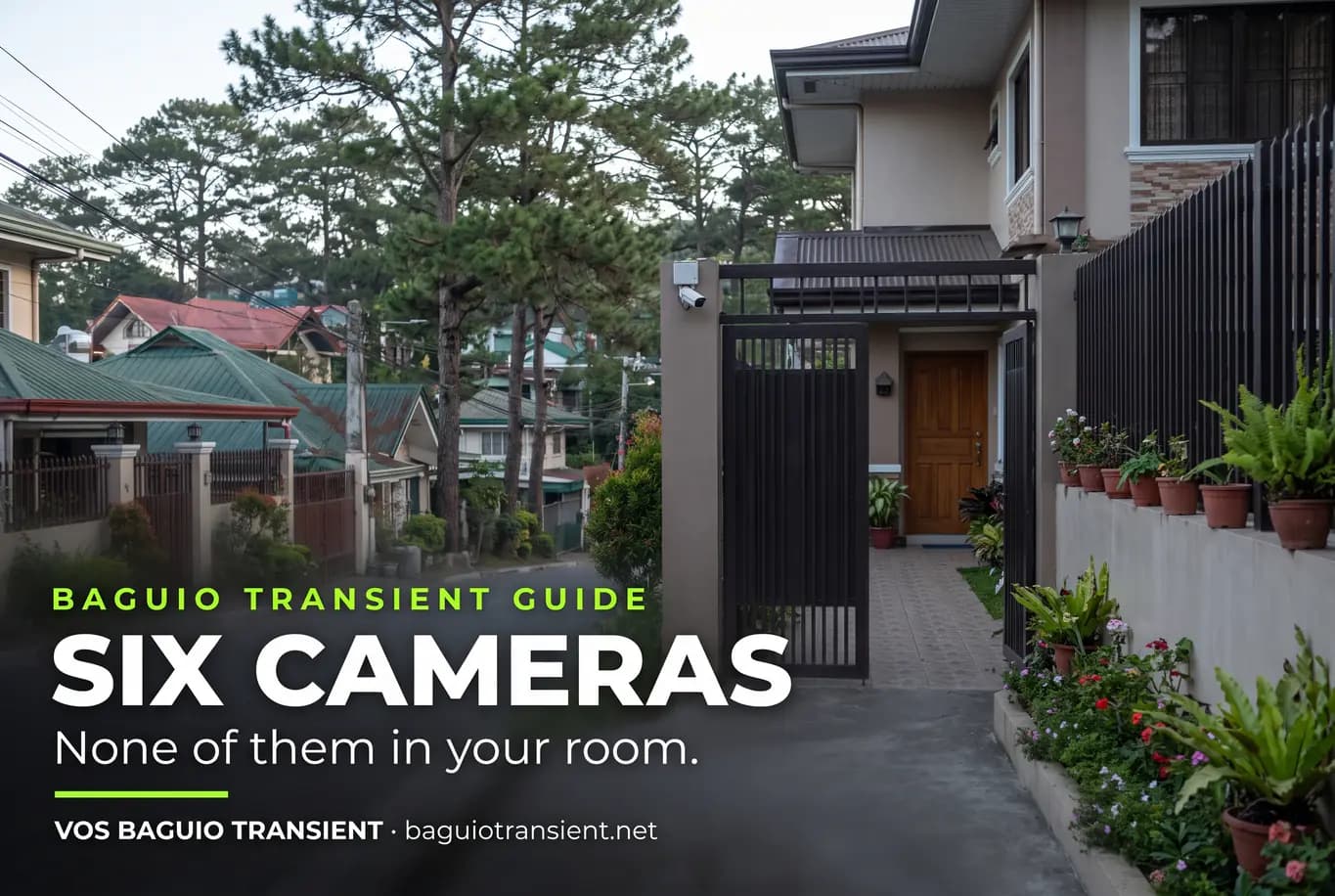
Almost every Baguio listing says the same three letters. CCTV. It has become one of those words that appears on every page and means nothing by the time you have read it twenty times. So let me tell you what it actually means at our house, including the parts that are less flattering. We have six cameras. None of them are in your room. They record continuously, and we almost never look at the footage. They also are not what is keeping you safe, which is the thing I most want to explain properly, because a camera has never stopped anybody from doing anything. This is the honest version: where the cameras are and where they deliberately are not, what recording actually buys you, what protects your laptop while you are out at the Night Market, and the questions to ask any host in this city before you hand over money. Then, ideally, you can stop thinking about all of it and enjoy the trip.
Six Cameras, and Exactly Where They Are
We have six CCTV cameras, scattered across the property.
They cover the sala and living room, the gate, and the pathways. In other words, the shared parts of the house and every route in or out of it. If you walk in through the gate, along the path, through the main door and across the living area, you have passed cameras the whole way.
That placement is not accidental. The point of cameras in a house like this is not to watch people. It is to have a record of who came in and who went out. Every entrance and every shared corridor is covered, and the moment you step into your own space, coverage stops.
Six is enough for a property this size precisely because they are on the routes rather than in the rooms. You do not need a camera in every corner if every way in and out is covered.
If you want the wider picture of how a legitimate transient here is set up beyond the cameras, I wrote that up in is a transient house safe in Baguio.
Pro Tip
Ask a host where the cameras are, not how many. Six cameras on entrances and corridors beats twenty pointed at nothing.
There Are No Cameras in Your Room
I want to state this plainly because it is the thing people are actually worried about when they read the word CCTV.
There are no cameras in the guest rooms. None. It is a private place for you to stay and it stays private.
There is nothing near the bathrooms either. The coverage is the sala, the living room, the gate and the pathways, and that is the complete list.
I think the reason this needs saying out loud is that hosts advertise CCTV as a feature without ever specifying where, and a guest reading that has no way of knowing whether it means the driveway or the bedroom. The absence of detail is doing a lot of work in those listings, and not in your favour.
So when you see CCTV on any listing in this city, treat it as an incomplete sentence. Cameras where? A host who genuinely has nothing to hide will answer that instantly and specifically. If the answer is vague, that is information.
Pro Tip
Never accept 'we have CCTV' as an answer on its own. Ask which rooms and areas are covered. A straight answer takes one message.
It Records. We Just Do Not Watch It.
The cameras record continuously. Everything that happens in the covered areas is captured, and it is kept as a record.
But here is the part that matters more than the recording, and that almost nobody says out loud: we do not sit and watch it.
We only go back to the footage if there is a complaint. If nothing has gone wrong, nobody is reviewing where you went and when you came back. That is a deliberate position, because respecting people's privacy and having a record of the property are two different things and I want both.
The recording exists so that if something does happen in future, there is evidence rather than two people's word against each other. That is genuinely all it is for. It is not surveillance of your holiday.
And for what it is worth, we have never had to pull footage over an incident. It has simply sat there, doing nothing, which is exactly what you want from a security system.
Pro Tip
Ask whether the system records or only shows a live feed. A live feed nobody is watching at 2 AM is decoration. A recording is evidence.
The Cameras Are Not the Security. We Are.
This is the most important thing in this post, so I will put it the way I actually say it.
We do not have any guards. We are here 24/7. We are the security, and the CCTV is just the online security.
A camera has never physically stopped anyone from doing anything. It records what already happened. What actually protects your things is that the owners live here, on the property, every day and every night. Somebody is always present. That is a completely different proposition from a lockbox handover at a unit where the owner lives across town and the only thing between your bag and the street is a door.
I will be straight about the trade-off, because it cuts both ways. There is no security guard on the gate. We are not a hotel with staff on shift. If you want a uniformed guard and a 24-hour front desk, a hotel gives you that and we do not.
What we give you instead is a family who lives in the building, knows who is meant to be here, and notices when someone is not. In a house this size that is worth more than a guard on a chair, and it is the reason we can run without any curfew at all while still sleeping fine at night.
Pro Tip
Ask whether the owners actually live on the property. On-site owners are the single strongest security feature a small transient can have, and it costs you nothing to check.
Three Keys: Gate, Main Door, Room
Cameras record. Locks are what actually stop things, and this is the layer that does the real work.
Every guest gets three keys. One for the gate, one for the main door, and one for your room.
So between the street and your bag there are three separate locked points, and you hold the key to all three. That is what is protecting your laptop while you are out at the Night Market, not the cameras. The cameras just mean that if all three of those failed, there would be a record of it.
The three keys are also what makes the no-curfew arrangement work. You let yourself through the gate, through the main door, and into your room without waking anybody, which is only possible because you were trusted with the full set in the first place.
And the keys cover the luggage situation too. If you need to drop bags before check-in or leave them after check-out, they sit inside the house under camera coverage rather than in a corridor or behind a desk.
Pro Tip
Count the locked points between the street and your room. One is a unit door. Three is a gate, a house and a room, and it is a completely different level of protection.
What the Cameras Actually Protect, and It Goes Both Ways
Here is something that surprised me when I thought about it properly. Guests almost never ask about the CCTV.
I expected security to be the big pre-booking question and it is not. People ask about curfew, about the walk to Session Road, about hot water. The cameras rarely come up. The person who relies on them most is me.
What they do is let me check the ins and outs of everyone entering the house. Who came in, who went out, and whether the person walking through the gate is actually someone who booked.
That protects you, because your bags are in this building and you want to know that only guests are moving around it. And it protects us, because if somebody is on the property who has not booked, they are not a guest. They are a bystander, and I want to know about it.
So the honest framing is that this is mutual. The cameras are not there to watch guests. They are there so that everyone in the building is someone who is supposed to be in the building, which is the same thing you want. The unwritten rules of staying in a transient house cover the other half of that, which is the part guests control.
Pro Tip
The real security question is not 'are there cameras' but 'how does the host know who is in the building'. That is what you are actually paying for.
How to Check Whether a Host's Security Is Real
Every listing in Baguio says CCTV. Some of those cameras are dummies, some are broken, some point at a wall. So here is how to tell.
First, just ask. Ask whether the transient house has CCTV, where the cameras are, and whether the system records or only shows a live feed. You are not being difficult. You are asking three factual questions that any real host can answer in one message.
Second, look when you arrive. Our units are real devices and they are visibly working, so you can see for yourself that they are running rather than taking my word for it. Real cameras look like real cameras. A dummy usually gives itself away with a fake blinking light and no cabling going anywhere.
Third, ask about the keys and the gate, because that is the layer that actually stops things. Ask how many locked points there are between the street and your room.
And fourth, before you pay anyone in this city, check the place is a real, established business. That single step filters out more risk than any camera. You can browse verified stays through BaguioTransient.net, compare a wider range through BookBaguio, and if you need a larger private space for a group, VOS Villa is worth a look.
Pro Tip
Three questions, sent before you pay: Where are the cameras? Does it record? How many locked points between the street and my room? Vague answers to any of them tell you what you need to know.
Then Stop Thinking About It
I want to finish somewhere other than a checklist, because the point of all of this is not to make you anxious.
When someone asks me what to do about security here, my honest answer is: relax, enjoy Baguio, have a good time.
That is not me dismissing the question. It is the whole purpose of the setup. Six cameras on the entrances, no cameras in your room, a recording nobody watches unless something goes wrong, three keys, a gate, and a family who lives here every day of the year. All of that exists so you can walk out of the door in the morning and not think about your bag once until you come back.
A place that makes you think about security constantly has failed at security, no matter how many cameras are on the wall.
So do the checking before you book, properly and without apology, and then let it go. To book with us directly, message facebook.com/vosbaguio or call 0936 895 6542. And if you are curious how a small family business here competes on honest content rather than a big budget, the case study on FreeUpToHours is worth a read.
Pro Tip
Do your security checking before you pay, then stop. The point of a well-run house is that you get to forget about it for the whole trip.
Frequently Asked Questions
Does VOS Baguio Transient have CCTV?
Are there cameras inside the guest rooms?
Does the CCTV actually record, or is it just a live feed?
Is there a security guard?
What actually stops someone taking my things?
Can I store luggage safely before check-in or after check-out?
How do I know a Baguio transient's CCTV is real and not a dummy?
Why does a transient house need CCTV at all?
Related Guides
The transient house behind this guide
Valencia VOS Baguio Transient
92-P Valenzuela Street — 3 minutes from SM Baguio. See the homepage Rooms & Rates section for prices by date and guest count. Family-run since 2020.