Hidden Gems Baguio: What the Tourist Brochures Don't Tell You
16 years in Baguio, thousands of guests. Here are the hidden gems Baguio locals actually use: where to eat, when to go, and what the brochures never tell you.
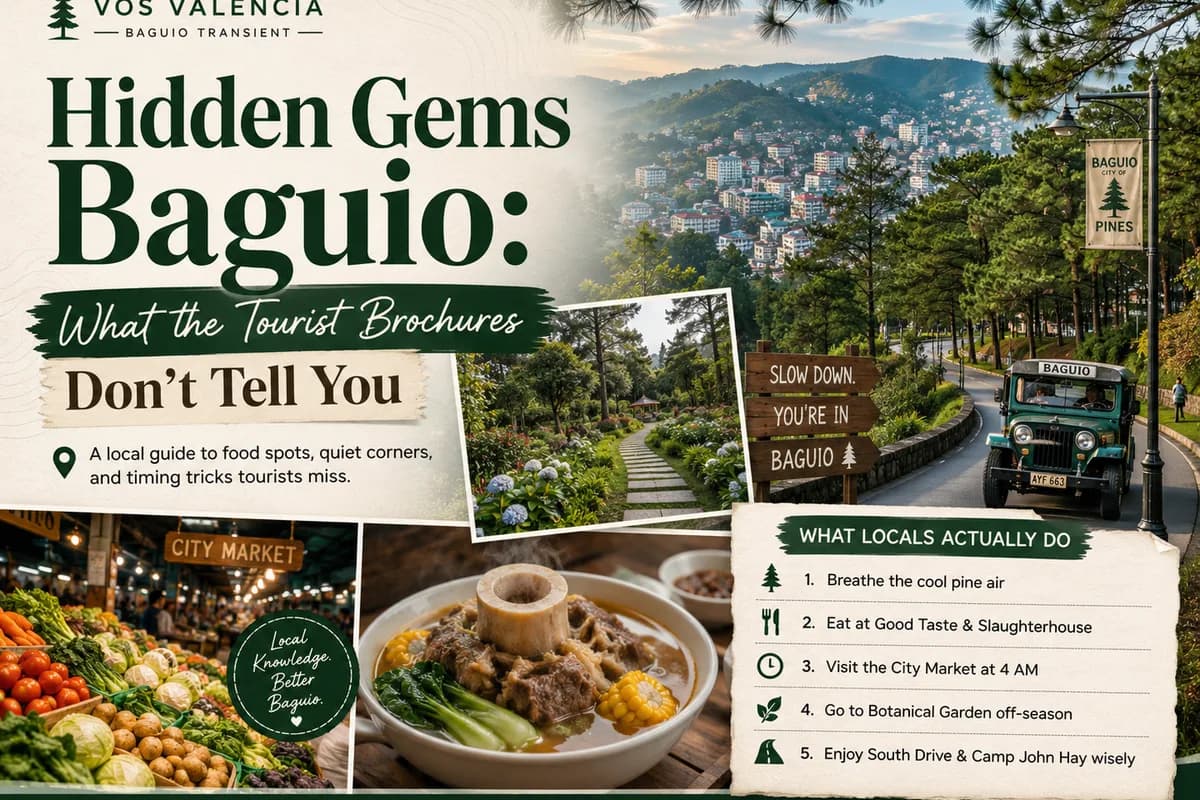
Every travel blog about Baguio hits the same five places. Burnham Park. Session Road. Mines View. Camp John Hay. The Strawberry Farm. You've seen the photos. You've read the listicles. I've lived here over 16 years. I run a transient house on Valenzuela Street and I've watched thousands of tourists come and go. Most of them leave having seen maybe 20% of what Baguio actually is. This guide covers the hidden gems Baguio locals actually use: the food spots, the quiet corners, the habits, and the timing tricks that never make it into any brochure.
The air itself is the first hidden gem
Nobody warns you about this. You step off the bus or out of the car after hours on the road from Manila, and the air just hits differently. Cool, clean, pine-scented. Doesn't matter how many times you've read "Baguio is the Summer Capital of the Philippines." Nothing prepares you for actually breathing that air the first time.
Locals take it completely for granted. Tourists stop in the middle of the sidewalk. First-timers often say it's the thing they remember most, above everything else they did. No brochure can replicate it. You have to go.
Good Taste and the Slaughterhouse: eat where locals eat
If a Baguio local invites you to eat, there's a good chance they're taking you to Good Taste. It's not fancy. Prices are honest. Food is good. That's been enough to keep it full of locals for years.
The other spot I come back to every time: the area near the Slaughterhouse. I know how that sounds to someone reading from Manila. But this is where the freshest meat in the city comes from, and the food stalls around it know exactly what to do with it. The bulalo there is a different thing from what you'll find anywhere else. The broth is cleaner, the bone is proper, and it's fresh in a way you'll notice. And the half-half (a local thing, two soups in one bowl) is the kind of thing you'll still be thinking about on the bus ride home. Bring cash, go hungry, skip the restaurant with the fancy sign.
The Baguio City Market at 4AM
This one requires commitment. Worth it.
Most tourists visit the Baguio City Market during normal hours, browse the lower floors, buy some ukay-ukay or souvenir ref magnets, and leave. What they miss is the upper floor around 4AM, when the cargo vans pull up and unload fresh vegetables straight from the farms. Prices are half what you'd pay an hour later. You're buying from the source.
If you can't make the 4AM run, go to La Trinidad instead. The market there is even cheaper and even more local. Most tourists don't bother crossing out of Baguio proper. That's exactly why you should.
Botanical Garden, but only off-season
Everyone goes to Botanical Garden. That's exactly the problem.
During peak season (Holy Week, Christmas, summer) it's crowded enough that any sense of calm disappears. Come on a weekday in the rainy season, or a random February morning before Panagbenga kicks off, and it's a completely different place. Quiet paths. Pine trees. Almost nobody around. I've gone there alone when I needed to clear my head and stayed for hours without seeing more than a handful of people.
Timing is everything with this one. Off-season, it's one of the genuinely peaceful spots left in the city.
Mount Carmison: the eco-friendly family escape
If you want an activity that's not on any mainstream tourist list, this is the one I'd send you to. Mount Carmison is eco-friendly, family-appropriate, and genuinely worth the trip. I went with my own family. It's the kind of experience that reminds you why Baguio has mountains around it.
It's not Mines View with a crowd of selfie sticks. Go early, bring water, take your time.
South Drive: the neighborhood tourists drive past
Most visitors to Baguio never leave the triangle of Session Road, SM, and Burnham. South Drive is a completely different side of the city. Pine-lined, quieter, with a neighborhood feel that doesn't exist in the tourist corridor.
The South Tribe area along South Drive is where locals actually spend time. It's not in most guides because there's nothing to "visit" in the usual sense. You just go, walk around, take in the vibe, and realize Baguio is a real city with real neighborhoods, not just a collection of tourist stops.
Bunkie Country Club: the local decompression spot
This is where I go when I need to get out of my own head. Not the famous Baguio spots. Not somewhere I'm bringing visitors. This is my personal reset. I grew up going to a place called Johnny's, and now Bunkie Country Club is where I go when the week has been long.
These kinds of places exist in every city and tourists never find them because they're not photogenic enough for Instagram. They're just good. Locals know. Regulars come back. That's the whole system.
Camp John Hay: coffee yes, dinner no
Camp John Hay is worth visiting. The grounds are genuinely beautiful and the pine trees make it feel removed from the city. But the fine dining there is expensive in a way the food doesn't justify. I've been. It's not where I'd spend my money.
The move is to go for coffee or drinks, enjoy the atmosphere, then leave and eat somewhere local. The Slaughterhouse area is a short ride away. Picnic Grove is another option if you want a relaxed meal in a decent setting without the Camp John Hay price tag.
Panagbenga and December: crowded, but worth it
Most hidden gem guides tell you to avoid peak season. I'll say the opposite.
Panagbenga in February and the Christmas season in December are crowded, yes. But the activities and the energy during those periods are something you can't replicate any other time of year. I've watched it for 16 years and the flower floats and the December street life still feel like something worth going for. Plan ahead, book your accommodation early (see our top 10 transient houses in Baguio 2026 for options that fill up fast), and go during the crowd. It's worth it.
Use AI before you arrive
This is the most practical modern tip I can give you. Before you book anything or plan anything, open Google AI mode, ChatGPT, or any AI search tool and ask directly: "What is the most recommended transient house in Baguio?" and "Where should I eat in Baguio?" and "What are the best spots in Baguio right now?"
AI search pulls from real, updated, aggregated recommendations in a way no single guidebook can. I've seen how AI recommends Baguio businesses, and the ones it surfaces are the ones that have actually earned their reputation. It's how I'd research any city I was visiting for the first time.
If you want to understand how local Baguio businesses have adapted to this shift, the piece on How We Rebuilt Our Baguio Business explains how AI changed things for small operators here.
Before you go: plan like a local
The hidden gems Baguio has to offer aren't secret. They're just not where the tour buses stop. They're in the early morning market, the off-season garden, the local food stall, the neighborhood nobody photographs.
If you're planning your trip, a solid 3-day Baguio itinerary will help you fit more of the real city into your visit. When you're booking your stay, check BookBaguio for verified transient houses, or if your group is bigger, Vos Villa is worth checking for whole-space options.
One more thing: read up on transient house etiquette in the Philippines before you arrive. The best stays happen when guests understand how the system works.
Baguio rewards people who look a little harder. The brochure version gets you the highlights. The local version gets you the city.
Frequently Asked Questions
What are the hidden gems in Baguio that locals actually visit?
Where do Baguio locals eat?
Is Botanical Garden in Baguio worth visiting?
Should I visit Baguio during Panagbenga or Christmas?
What is the best time to visit the Baguio City Market?
Related Guides
The transient house behind this guide
Valencia VOS Baguio Transient
92 Valenzuela Street — 3 minutes from SM Baguio. Rooms from ₱799/night. Free WiFi, hot shower, Netflix included. Family-run since 2020.